Keeping with the nursing programs of the College of Nursing, the MSN program believes that:
Each individual is a unique person having dignity and worth. Individuals, as members of the family and the community, are shaped by cultural, physiological, psychosocial, spiritual, and developmental forces. The family and the community influence early beliefs and values of individuals, and in turn individuals contribute to the effective functioning of the family and community.
Nursing is both an art and a science grounded in a social context and related to experiences with people in need. It is based on a specific body of nursing theory and principles from behavioral and social sciences. Nursing is an interpersonal process and involves the application of knowledge, technical and collaborative skills, critical thinking and creative problem solving. The focus of nursing is on caring for individuals, families, or client groups. By using the nursing process, nurses promote, maintain, and restore client health as well as provide compassionate care to the dying. As health care providers, nurses engage in a collaborative practice that focuses on outcomes and adheres to practice guidelines that ensure quality and access.
Professional values and value-based interventions are fundamental to nursing education. As the basis for professional nursing practice, values and value-based actions may be viewed as ethically reflective practice that the nursing student uses to interact with patients, health care professionals, and society.
Teaching and learning are life-long interactive processes through which active inquiry and participation result in a change in behavior. A teaching/learning process is facilitated when the learner and teacher share responsibility for outcomes. Learning is facilitated when content is presented in an orderly sequential manner (i.e. simple to complex, known to unknown, normal or abnormal, general to specific).
Critical thinking, clinical competence, accountability, and a commitment to the value of caring is necessary to maintain or restore clients to their optimum state of health and to provide the support which allows death with dignity. As the provider of care, the nurse’s commitment to client/family-centered care will facilitate successful preparation for practice in various health care settings.
It is essential that the nurse have current knowledge in nursing concepts, principles, processes, and skills. Supportive of that knowledge is an understanding of health, acute and chronic health deviations, nutrition, pharmacology, communication, human development, teaching/learning principles, current technology, humanities, and biological, social, and behavioral sciences.
The nurse is a manager of care in various health care settings where policies and procedures are specified and guidance is available. To be competent in the role as a manager of care, the nurse must possess the knowledge and skills necessary to make decisions regarding priorities of care, to delegate some aspects of nursing care, and direct others to use time and resources efficiently, and to know when to seek assistance. Supporting this knowledge is an understanding of the principles of client-care management, communication and delegation, legal parameters of nursing practice, and roles and responsibilities of members of the health care team.
Organizing Framework of the MSN Program
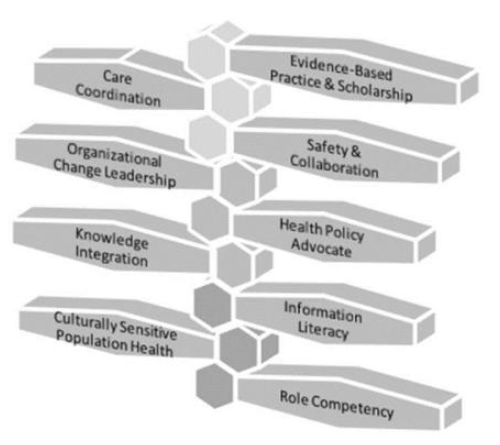
The roles and functions of the MSN nurse graduate expand from the BSN level. The framework for the MSN programs is built on the AACN Essentials of Master’s Education in Nursing (2011). Graduates of the MSN programs will possess “broad knowledge and practice expertise” beyond the baccalaureate degree and the roles of health care leader, care manager, contributor to the profession, and community collaborator. Graduates will be prepared for work in current and future innovative environments where nursing and healthcare are delivered. Graduates will utilize technology to solve unique as well as global nursing issues, and learn to coordinate care by communicating across the boundaries of degrees, departments, facilities, and states. Graduates are prepared to educate patients, families, groups, students, and each other. Graduates in direct-care roles will possess graduate-level knowledge in assessment, pharmacology, and pathophysiology; and, have precepted learning experiences. Expectations for graduates will focus on patient safety, quality healthcare, and impacting the systems that provide care.
Graduates will exemplify the Institute of Medicine (IOM) core competencies of all health care professionals (2003) by providing patient-centered care that identifies and respects patients' individual needs and differences. Graduates will work in interdisciplinary teams to promote care that is continuous, reliable and will use evidence-based practices to transmit research into practice. Quality improvement techniques will be applied to identify hazards to patient care, understand safety design principles, and measures of quality. Graduates will also use information technology to communicate with each other and reduce the chances for error.
Additionally, the MSN program will use the teaching methods that support the use of technology and teach for a sense of salience, situated cognition and action in particular situations; integrate classroom and clinical experiences where appropriate; emphasize clinical reasoning and multiple ways of thinking; and emphasize role formation in graduate roles.